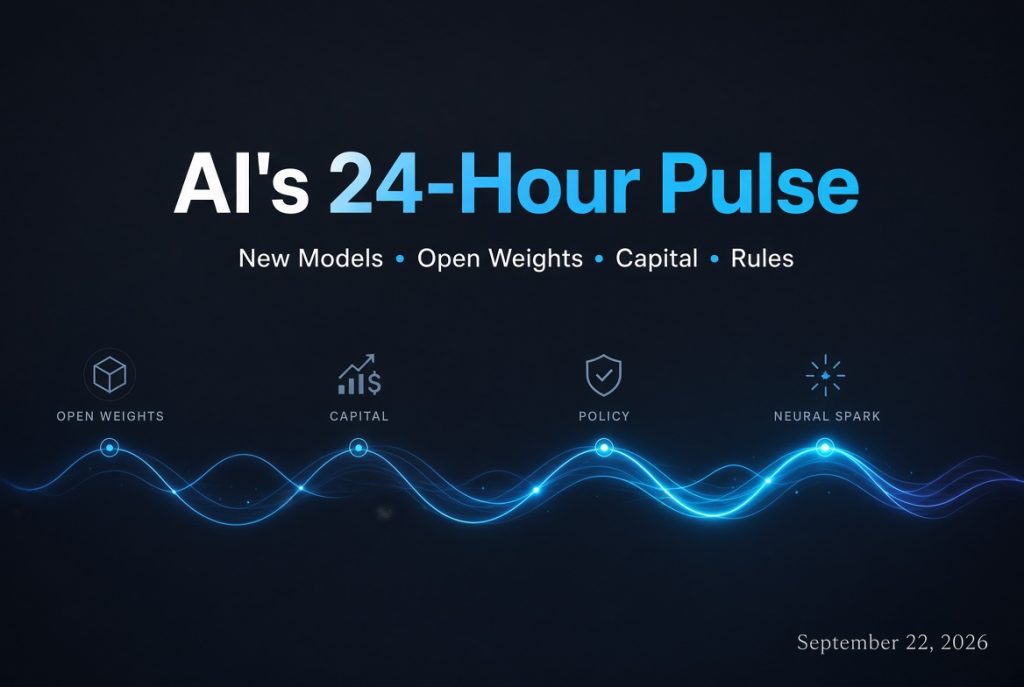
The last day in AI felt less like incremental progress and more like a simultaneous push on every front that matters: new frontier models, open-weight releases that claim to match closed systems, serious research on long-running agents and physical AI safety, fresh capital into applied agents and inference infrastructure, and—most notably—policy moves that start to look binding rather than aspirational.
Here is what actually moved the needle in the past 24 hours.
Models That Ship
xAI released Grok 4.7, optimized for long-horizon coding and multi-hour knowledge work, at the same price point as Grok 4.6 ($2 / $6 per million input/output tokens). Company messaging emphasizes longer reasoning and safety upgrades; independent indexes still place it mid-pack relative to the current Claude and GPT-class leaders. The real signal is commercial: cheap, persistent agents are becoming the product, not just peak benchmark scores.
Almost simultaneously, Xiaomi open-sourced MiMo-V2.6 Pro and the accompanying Flash MoE variant (309B total / 15B active parameters, 256K context) under an MIT license. The company claims parity with leading closed models on several tasks. Another large Chinese lab putting competitive multimodal weights on Hugging Face keeps pressure on both closed labs and the assumptions underlying export controls.
Yandex also shipped Alice AI Foundation, an 80B commercially usable base model with Russian-language evaluations and a sparse activation design—another data point in the growing set of sovereignty-oriented open weights outside the US/China axis.
Research That Matters
OpenAI announced an external math advisory group after reporting that its systems have resolved more than 100 open mathematical problems. The group can advise on review and release standards; it has no authority over OpenAI’s training pace. Treating “AI does original math” as a public-science event rather than an internal claim is a notable shift in posture.
Microsoft Research open-sourced RetroChimera, a chemical-synthesis planner that ranks free-form molecular predictions against template-guided ones—useful precisely where rare reactions break conventional tools.
Nvidia introduced Halos, a layered safety architecture for physical AI that spans autonomous vehicles and robotics across hardware, operating systems, and validation tooling. As autonomy moves from demos to fleets, safety is becoming a product category.
Two inference papers also circulated widely: RBS-Attention (a training-free sparse prefill method for long context) and Attention-Aware Routing for Mixture-of-Experts models. Long-context cost and routing quality are now the practical bottlenecks that decide whether agents can run all day.
Separately, a16z-backed Vals is building a neutral model-benchmarking platform. Self-reported evals have lost credibility; buyers need a third-party scoreboard.
Capital Still Flows
Corridor closed a $25 million seed led by Bain Capital Ventures (with operators from OpenAI, Scale, and Ramp) to rebuild SMB health-benefits brokerage with AI agents—an applied bet on messy, regulated workflows rather than another foundation-model raise.
Gimlet Labs raised roughly $300 million led by Andreessen Horowitz at a $3 billion valuation, focused on a chip-pairing approach to inference cloud. Capital continues to concentrate in specialized inference infrastructure even as model names cycle weekly.
Other checks in the same window included Cornelis Networks (~$205 million), Tandem Health (£75 million Series B), and Nvidia-backed Nscale preparing a Wall Street listing after a $14.6 billion valuation.
Policy Starts to Bite
OpenAI publicly called on the U.S. Congress for binding safety rules and shared international standards for evaluating self-improving systems—a clear reversal from earlier resistance to hard regulation. A frontier lab is now lobbying for enforceable rules.
California Governor Gavin Newsom signed a data-center package addressing power, water, and local infrastructure costs, plus an executive order accelerating independent frontier-AI audits that could include on-site reviews and emergency shutdown mechanisms. The largest AI state in the U.S. is attaching real costs and audit power to model scale.
The EU moved toward energy and water efficiency labels for large data centers. Twenty-two countries backed keeping AI under human control, with discussion of a new international institution. A UN independent panel urged governments to constrain autonomous agents, and China proposed tighter rules on AI virtual companions for minors. Compute and agent autonomy are becoming regulated objects, not just model weights.
What It Adds Up To
In a single day we saw open and mid-priced long-horizon models ship, labs professionalize math and physical-AI safety claims, capital continue pouring into inference and applied agents, and both OpenAI and California move policy from talk toward binding constraints.
The pace remains frenetic. The interesting question is no longer whether the next model will be better, but which combination of open weights, durable agents, infrastructure, and regulation actually compounds into durable advantage.
The next 24 hours will almost certainly deliver another wave. The ones that matter will be the ones that change what builders can ship, what enterprises will pay for, and what governments are willing to enforce.