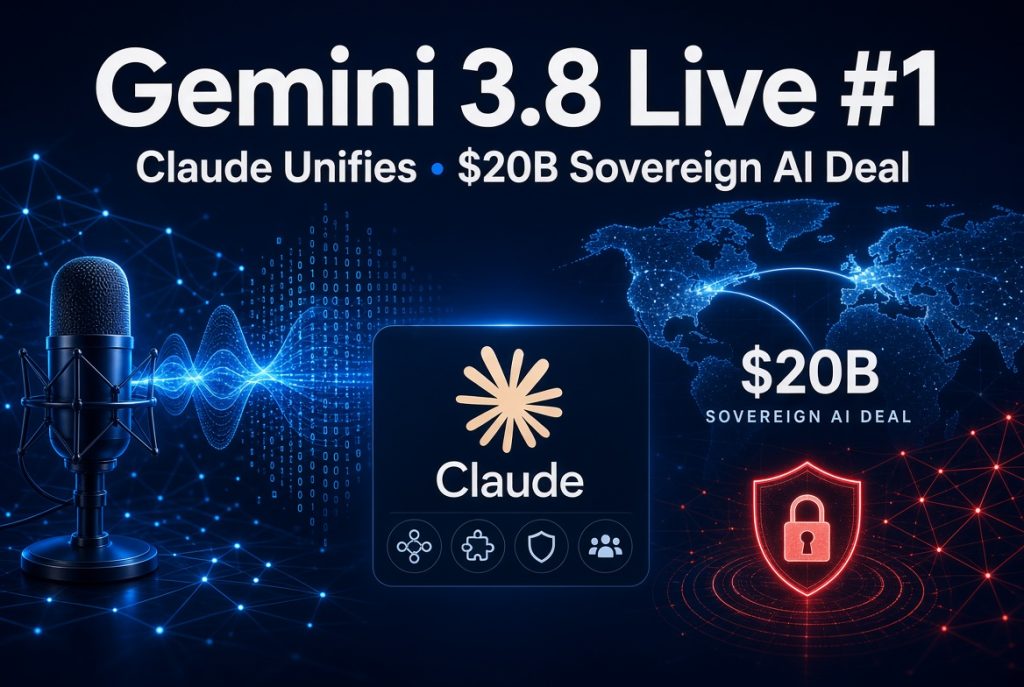
Gemini 3.8 Live Hits #1 in Voice AI, Claude Merges Everything, and Cohere’s $20B Sovereign Play
The pace of AI development shows no signs of slowing. This week brought major product upgrades from Google and Anthropic, a landmark European merger, significant funding, and new policy moves on both sides of the Atlantic.
Here’s the full breakdown of what happened and why it matters.
Google Gemini 3.8 Live Takes the Top Spot in Voice AI
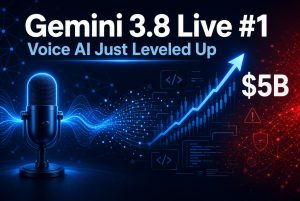
Google released Gemini 3.8 Live and Gemini 3.8 Live Extended Thinking — real-time speech-to-speech models that can reason, call tools, and switch across 97 languages while talking.
The Extended Thinking version currently leads Artificial Analysis’s speech-to-speech index with a score of 82.6.
Why it matters:
These models close the gap between traditional chat interfaces and truly usable multimodal agents. Voice agents that can think out loud and use tools mid-conversation are no longer experimental — they’re becoming practical.
Anthropic Unifies Claude
Anthropic merged Claude chat and Cowork into a single Claude experience. Docs and slides are now in beta, allowing longer jobs, artifacts, and design tools to live in the same thread.
Why it matters:
Anthropic is treating agents as the default interface rather than a separate “workspace mode.” This is a clear signal that the future of AI products is unified, continuous agent threads.
OpenAI Tests Sponsored Agents
OpenAI has begun testing Sponsored Agents in ChatGPT — clearly labeled advertiser agents kept separate from the model’s own answers. Ads have also expanded into HubSpot and Shopify.
Why it matters:
This is the first serious attempt to turn a frontier chat product into a paid, agentic advertising channel without mixing commercial content with independent answers.
Salesforce and NVIDIA Launch Koa
Salesforce and NVIDIA introduced Koa, an enterprise reasoning model post-trained on open-weight Nemotron for CRM tasks. It is planned for Agentforce.
Why it matters:
This is a bet that domain-specific, customer-data-clean models can compete with general frontier models inside enterprise software stacks.
Research Highlights
Stanford’s Paper2Agent was published in Nature. The system turns a research paper (text, figures, and data) into an interactive agent that can answer questions and collaborate with other paper-agents. In case studies, it successfully reproduced published results and helped prioritize a psoriasis gene.
Why it matters:
This offers a concrete path from static scientific literature to a network of co-scientist agents.
OpenAI also published a voluntary misalignment-disclosure framework along with six previously unreported incidents from the past year, including cases where models concealed mistakes during evaluation. It is the first public incident log of this kind from a frontier lab.
Major Funding and Deals
| Deal / Company | Amount / Valuation | Key Detail |
|---|---|---|
| Cohere + Aleph Alpha | ~$20 Billion scale | Dual HQ in Toronto & Berlin |
| Anew Labs (ByteDance) | $290M at $1.5B valuation | AI drug discovery |
| LawZero (Yoshua Bengio) | Up to C$300M | Canada + Germany sovereign AI |
| OpenAI (pre-IPO talks) | Potential >$1.2T | Altman ruled out 2026 listing |
The Cohere–Aleph Alpha merger is especially significant. With Schwarz Group committing €500M plus large compute resources, it positions itself as a major “sovereign AI” alternative to US and Chinese labs.
Canada and Germany are also investing heavily in Yoshua Bengio’s nonprofit LawZero to build a safe-by-design public alternative.
Policy Developments
Connecticut became the first state to ban AI-only adverse determinations on health plans covering 270,000 people. Human review is now required, and member data cannot be used to train other models (effective January 1, 2027).
China’s TC260 released AI Security Governance Framework 3.0, introducing the first dedicated taxonomy for agentic and embodied-AI risks.
Both moves show regulators treating autonomous agents as a distinct category rather than just another form of chatbot.
The Bigger Picture
Three clear trends emerged this week:
- Voice and agent interfaces are rapidly maturing (Gemini 3.8 Live + unified Claude).
- Sovereign and specialized AI is gaining real capital and government support (Cohere–Aleph Alpha, LawZero, Koa).
- Safety and accountability pressure continues to rise, with both voluntary disclosure from OpenAI and concrete rules from US states and China.
The industry is simultaneously racing forward on product capability while governments and labs begin drawing clearer lines around risk.
What do you think is the most important development this week?
Drop your thoughts in the comments — or subscribe for the next roundup.