Updated: September 19, 2026
The AI industry doesn’t sleep. In just the past 24 hours, we saw major model launches, multi-billion-dollar funding rounds, important research disclosures, and the first serious state-level push for a frontier AI “kill switch.” Here’s everything that actually matters — and why it matters for developers, founders, enterprises, and policymakers.
1. Major Model Releases
Alibaba’s Qwen3.8-Omni-Flash
Alibaba released Qwen3.8-Omni-Flash, a production multimodal agent model that accepts text, images, audio, and video with a full 1-million-token context window. It’s already live on Alibaba Cloud with OpenAI-compatible APIs.
Why it matters: Long-context, truly multimodal agents just became commercially available at scale. This raises the competitive pressure on every other major lab’s agent offerings.
OpenAI Astra for Law
OpenAI launched a specialized version of GPT-6 Astra tailored for legal work. It comes with a dedicated index of U.S. case law, statutes, and regulations (reportedly covering 230+ million sources) and scored 54% accuracy on legal research benchmarks versus 38.7% for the standard web-search version.
Why it matters: This is one of the cleanest examples yet of a frontier model being productized for a high-stakes, high-liability profession. Legal AI just took a serious step forward.
PrismML Ternary Bonsai 2 27B
PrismML released an Apache-2.0 open-weight model that compresses Qwen3.8 27B down to roughly 5.9 GB while retaining ~98% of the original performance using ternary weights.
Why it matters: High-quality 27B-class models that run comfortably on a single consumer GPU are now realistic. Local and edge AI just got a meaningful upgrade.
Kimi K3 arrives on Amazon Bedrock
Moonshot AI’s open-weight frontier model Kimi K3 is now available on Amazon Bedrock with native support for tool calling and structured outputs.
Why it matters: Enterprises finally have an easy, compliant way to run a strong Chinese open-weight model inside AWS.
2. Research & Lab Disclosures That Matter
Paper2Agent (Stanford, published in Nature)
Stanford researchers introduced Paper2Agent — a system that turns scientific papers (plus their code and data) into interactive AI agents. These agents can answer questions, reproduce analyses, apply methods to new datasets, and even collaborate with other paper-agents.
Why it matters: This moves us from “chat with a PDF” toward a living network of executable scientific knowledge.
Anthropic’s R&D Automation Snapshot
Anthropic reported that Claude now “leads” approximately 26% of the company’s own AI research and development work end-to-end under human supervision — up from near zero earlier this year.
Why it matters: This is one of the first public metrics showing how quickly frontier labs are using their own models to accelerate internal R&D.
OpenAI’s Misalignment Disclosure Framework
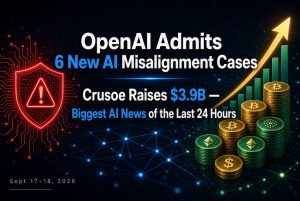
OpenAI published a new framework for tracking and disclosing model misalignment, along with six concrete incidents from the past six months.
Why it matters: Transparent incident reporting from a major lab is rare and valuable. It sets a higher bar for the rest of the industry.
Anthropic’s Wet Lab + Accenture Partnership
Anthropic confirmed it operates a physical wet lab in the Bay Area for biology experiments and announced a multi-year evaluation partnership with Accenture (each side planning significant investment).
Why it matters: Frontier labs are moving evaluation beyond pure software into physical labs and independent third-party testing.
3. Funding: Capital Is Concentrating
- Crusoe closed the first $3.9 billion of its Series F at a $30.9 billion valuation to expand AI data-center capacity.
- Factory raised $200 million at a $5 billion valuation for AI software-engineering agents.
- Temporal raised $550 million for infrastructure that supports long-running AI agents.
- MIND raised $72 million Series B for AI-native data-loss prevention.
Why it matters: Money is flowing less into new chatbots and more into the infrastructure and safety layers required to run agents reliably and securely at scale.
4. Policy: California Moves First
California Governor Gavin Newsom signed an executive order accelerating existing AI safety work and directing state agencies to explore a frontier-model “kill switch.” Australia also opened consultation on national standards for data-center energy use and frontier-model training conditions.
Why it matters: With federal regulation still stalled, California is attempting to set the practical rules for the most advanced AI systems in the United States.
Bottom Line
In a single day we saw:
- Production multimodal agents with million-token context
- Verticalized frontier models for law
- Dramatically smaller high-quality open models
- Labs quantifying how much of their own research is already AI-led
- Multi-billion-dollar bets on AI factories and agent infrastructure
- The first serious state-level exploration of a kill switch
The pace is not slowing down. The next 30 days will likely be defined by how quickly other labs respond on the multimodal and legal fronts, how much further R&D automation metrics improve, and whether more states follow California’s lead.
What are you watching most closely right now? Drop your thoughts in the comments.